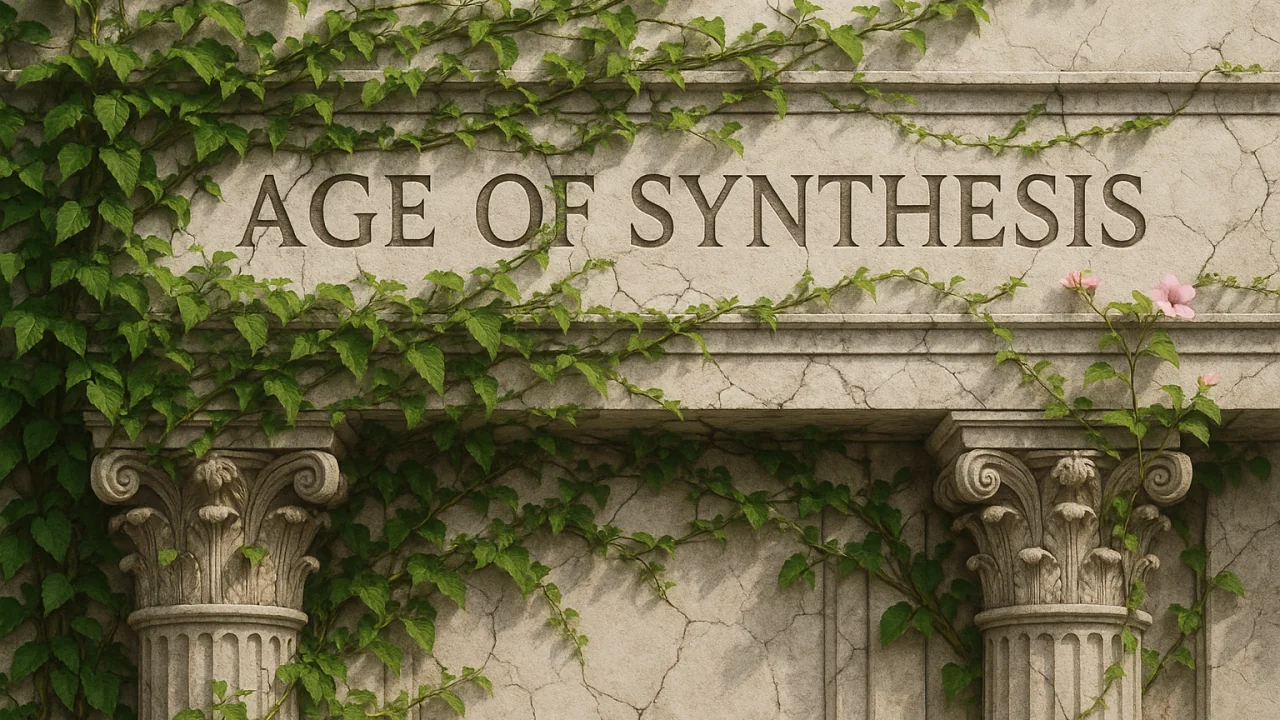
A field guide for those quietly building the future the old world tried to burn
We are not in an ordinary moment. The world is wobbling—its systems, its stories, its sense of self. But collapse is not the end. It is a turning.
I. The Premise
We are not witnessing a blip. We are living through a rupture.
The structures that once defined the “modern world”—governments, media, truth, leadership—are crumbling or mutating beyond recognition.
Call it collapse fatigue, cultural burnout, or geopolitical whiplash. Whatever name we give it, the sense is clear: things are breaking, and not softly.
But this isn’t the end of history. It’s a hinge in it.
We’re passing through what may come to be known as The Age of Unreason—a period where emotion trumps evidence, spectacle defeats substance, and decay is disguised as disruption.
And if we survive it, we may emerge into something radically different: The Age of Synthesis, where AI, science, human resilience, and a new kind of global empathy converge into a reimagined foundation for civilization.
This isn’t prophecy. It’s pattern recognition. And it’s time we start calling it what it is.
II. The Age of Unreason
The Traits:
- Information overload + meaning collapse
- Leaders without vision, institutions without spine
- Truth as tribal signaling, not shared reality
- Legacy systems patched into dysfunction
- Aged autocrats clinging to nostalgia and nukes
We are governed by men who remember the Cold War more vividly than they understand the cloud—leaders who measure success in GDP and personal wealth. At the same time, the planet melts, and the algorithm radicalizes teenagers before breakfast.
Reason hasn't disappeared. It's been sidelined—mocked as elitist, academic, or inconvenient. The Age of Unreason thrives not on ignorance but on the active, often strategic rejection of knowledge.
It's performative. It's profitable. And it's contagious.
This age is not simply stupid. It is infected by willful unknowing—a feedback loop of fear, power, and distraction that treats critical thinking as an enemy combatant.
III. Collapse Isn’t Uniform—But It’s Contagious
Different systems are unraveling at different speeds:
- In politics, demagogues rise not because they solve problems but because they mirror frustration.
- In media, platforms prioritize engagement over truth, turning every conflict into content.
- In society, trust dissolves, attention splinters and shared purpose gives way to micro-identities and rage.
Climate systems, economic order, and global alliances are not immune to these changes. They're fraying. Not suddenly, but systematically.
And here's the quiet terror: collapse doesn't always look like chaos. Sometimes, it looks like bureaucracy, business-as-usual, or endless "technical difficulties." Like the light still being on in the room while the foundation quietly rots.
We're not sleepwalking into a cliff. We're wide awake, doomscrolling as we fall off it.
IV. The Remix, Not the Reset
There is no going back. Nostalgia is not a roadmap.
What comes next—if it's to be something better—won't be a reset to the old normal. It'll be a remix, a reassembly of knowledge, systems, and sensibilities. What survives the fire must be forged into something new.
This is The Age of Synthesis. And it's already starting to flicker in:
- The rise of AI not as overlord but as amplifier of human insight
- Decentralized systems that redistribute trust and control
- Younger leaders unwilling to play the game by the old rules
- A reawakening of interdependence over dominance
The Age of Synthesis is a slow, sometimes silent resistance to the unraveling. It is creative, stubborn, deeply moral—and rooted in the idea that complexity is not the enemy of clarity and that empathy is not a weakness but a vital infrastructure.
This future isn't guaranteed. But neither was the Renaissance. It came after plague, war, and religious extremism. What mattered then—and what matters now—is that a few people dared to think forward. To learn, combine, and evolve.
We may be bruised by unreason, but we are not beaten by it.
You and I—we are the seeds of the Synthesis.
V. Designing for Synthesis
Synthesis doesn't self-assemble. It must be shaped—intentionally, inclusively, iteratively. This isn't about building a utopia. It's about designing systems and cultures that can adapt, uplift, and endure.
What It Might Look Like:
- Education that teaches pattern recognition, not memorization. Systems thinking, emotional literacy, media fluency.
- Governance with transparency by default, AI-assisted policy modeling, and feedback loops that actually feed back.
- Economics that measures human well-being, ecological impact, and long-term resilience—not just quarterly earnings.
- Technology built with ethical scaffolding. Open-source where possible, human-first always.
Who Leads?
Not just governments. Not just tech companies. This belongs to:
- The bridge-builders who speak across divides
- The tinkerers who test and iterate better tools
- The artists and writers who reframe possibility
- The quiet rebels in cubicles and codebases
Leadership in the Age of Synthesis won't wear epaulettes. It will ask better questions, resist simple answers, and nurture capacity over control.
There's no central plan. No manifesto to follow. Just people like you, like us, refusing to let entropy have the final word.
VI. Seeds in the Ashes
The ashes are real. Institutions are brittle. Social trust is low. The ground is scorched. But history reminds us that some seeds need fire to germinate.
This isn't metaphor—it's method.
What's Already Sprouting:
- Communities reclaiming local resilience: food systems, energy grids, mutual aid.
- Technologists pivoting from growth-at-all-costs to building tools for trust, transparency, and safety.
- Writers, educators, and creators showing up as public philosophers—narrating new futures, not just documenting the fall.
Even the fractures in our systems are creating unexpected alliances. Scientists working alongside indigenous leaders. Hackers partnering with civil rights advocates. Artists collaborating with policy thinkers. The coalitions that emerge from necessity may be the ones that endure through choice.
How Do We Protect the Seeds?
- Shield truth in a time of distortion.
- Mentor courage in spaces where fear is the default.
- Build redundancy, not dependence—in data, governance, infrastructure, and relationships.
- Make beauty visible, especially where the pain is loud.
This isn't about mass movements (yet). It's about distributed defiance. Tiny revolutions in boardrooms, classrooms, codebases, and kitchen tables. A refusal to give in to decay—not out of naiveté, but out of stubborn belief that better is still possible.
So when the ground trembles again—and it will—look not to the rubble but to the people planting things anyway.
VII. The Long Now
Synthesis isn't just about surviving collapse. It's about what survives us.
In the Age of Unreason, time shrinks. Everything is urgent, reactive, performative. Leaders chase election cycles. Companies chase quarters. Algorithms chase attention. Meaning, direction, and wisdom get flattened into the next notification.
But building anything lasting—anything worth calling civilization—requires a different clock.
Welcome to The Long Now.
Deep Time as Design Principle
The Long Now is the mindset that stretches the horizon—not to escape the present, but to give it depth. It asks:
What kind of ancestor do you want to be? What institutions still make sense in 100 years? How do you write code, law, or culture that outlives you?
This isn't theoretical. It's architectural.
Some cultures have always known this. Indigenous communities that plan for seven generations. Cathedrals that took centuries to build. Farmers who plant olive trees they'll never harvest. It's not slowness—it's scale.
Synthesis at 100-Year Speed
In the Age of Synthesis, we don't just need fast prototypes. We need durable intentions.
That means:
- Policy frameworks that adapt over decades, not press cycles.
- AI systems that don't just answer faster but understand longer.
- Education that prepares students not just to work but to steward.
- Infrastructure that holds up to both climate and culture.
This is not romantic idealism. It's existential realism. The problems ahead—ecological, technological, geopolitical—require tools, ethics, and institutions designed to outlive the people who built them.
Cathedral Thinking
We need to get comfortable building things we won't finish.
The Age of Unreason fetishized disruption. But the Age of Synthesis will rediscover something deeper: cathedral thinking—crafting structures so sound, so meaningful, they'll shelter people you'll never meet.
Maybe that's a data trust. Perhaps it's a city charter. It could be a story.
What matters is that we build with continuity in mind—because if we don't, the subsequent rupture will be worse.
What Does the Long Now Look Like Today?
- The Long Now Foundation, literally building a 10,000-year clock in a mountain.
- Intergenerational climate lawsuits—youth suing on behalf of future generations.
- Slow cities, permaculture, open data archives, and public infrastructure designed to heal.
Not all of it works. Not all of it has to. But each piece is a signal flare from the future, saying: you are not the end of the story.
You Are a Time Machine
Every action you take—what you teach, what you code, what you preserve—is a message in a bottle to a future you won't see. But someone might.
That's the Long Now.
And if the Age of Synthesis is to be real—not just poetic—we need more than clever ideas. We need a clock reset. We need to reorient our compass to care not only about what's next—but about what's after that.
VIII. The Quiet Blueprint
Big change doesn't always start with declarations. Sometimes, it starts with a whispered no. A quiet rebuild. A choice not to look away.
The Age of Synthesis won't arrive with fireworks or fanfare. It'll arrive in fragments—assembled slowly, persistently, by people who don't need permission to start building what comes next.
This is the quiet blueprint. It's not exhaustive. It's not prescriptive. It's a scaffold—a way to begin, from wherever you stand.
1. Reclaim Your Signal
In an age engineered for noise, attention is power.
- Mute the spectacle.
- Choose inputs that nourish.
- Audit your feeds, your time, your tolerances.
Information isn't knowledge. Volume isn't clarity. And your mental bandwidth is worth defending.
2. Build Local Resilience
Global systems may stutter, but communities can steady themselves.
- Learn your local infrastructure.
- Support mutual aid and public libraries.
- Map your dependencies—and shorten them.
Resilience isn't just batteries and broadband. It's trust, memory, and shared rituals that keep people human when systems fail.
3. Practice Radical Pattern Recognition
Synthesis depends on seeing across boundaries:
- Read outside your discipline.
- Ask: "What's the system beneath the symptom?"
- Think like a coder, a poet, a parent, and a planner—all at once.
If the Age of Unreason was about isolation and silos, Synthesis thrives on connection and translation.
4. Embed Ethics in the Stack
Whatever you build—an app, a policy, a classroom—embed conscience early.
- Who benefits? Who pays?
- What assumptions are you carrying forward?
- Can it be audited, challenged, rebuilt?
Tech ethics isn't a department. It's a design requirement.
5. Default to Open
Transparency invites trust. Open-source, open-data, open-process—these aren't just ideals; they're strategic defenses against the brittleness of closed, corrupted systems.
The more that survives in the open, the more future-proof it becomes.
6. Mentor Forward
Synthesis isn't a solo act.
- Share tools. Share wisdom.
- Translate the world for those just entering it.
- Make it easier for someone else to build further than you could.
Teaching is the most radical form of optimism.
7. Tend to Beauty
Beauty is not a luxury. It's a fuel cell for the human spirit. In times of collapse, beauty reminds us why we rebuild.
Art, music, ritual, poetry—they don't solve systems, but they help us survive them.
8. Stay Decent in a Cruel Timeline
Kindness isn't weakness. In fact, it may be the last sustainable advantage.
When you can't solve everything, solve for decency. Be the person someone else would want in a crisis. Even if you never get credit. Especially then.
We don't need perfect plans. We need people who keep moving toward better even when worse is louder.
This is how you build a future quietly:
In code. In care. In stubborn, everyday acts of construction.
Because even in the dark, even in the noise, you are part of the blueprint.
IX. After the Fire
What does the world look like after the fire? Not just the end of collapse, but the beginning of coherence?
It's not chrome cities and utopian skylines. It's quieter than that. Gentler. Stranger.
After the fire, there is clarity.
It Feels Like…
- Fewer headlines. More throughlines.
- Systems that bend instead of break.
- A redefinition of wealth: clean air, time to think, trust that doesn't need to be surveilled.
- Technology that serves—not manipulates.
- Cities built for feet, not fuel.
- Leaders who listen more than they brand.
- Education that teaches how to learn, unlearn, and reimagine.
It's not perfect. It's not painless. But it's possible.
The Old Gods Are Gone
Authoritarian nostalgia, surveillance capitalism, fossil-fueled geopolitics—these were the empires of the fire. Some burned quickly. Some died slowly. But all fell to their inability to adapt.
In their place, distributed power, civic AI, ecological governance, and polycentric trust networks begin to root.
History doesn't end—it simply rescripts. And in this version, no single actor owns the plot.
Scars Remain—and That's OK
Not everything heals. Some cities stay underwater. Some borders never open. Some people never come home.
But the new age doesn't pretend it didn't happen. It integrates. It remembers. It teaches.
Resilience isn't the absence of pain—it's the ability to carry it without dropping everything else.
What Survives
- Books. Seeds. Protocols. Stories.
- Open systems.
- Quiet courage.
- The names of those who kept building when it looked pointless.
- The blueprints drawn in notebooks no one was supposed to see.
And maybe, just maybe, the idea that progress isn't a race—it's a relay.
After the fire, we don't go back. We go forward with scars, forward with Synthesis.
And it starts, as it always has, with someone saying:
"We could do it differently this time."
X. Notes for the Builders
You don't need to be powerful to shape the future.
You just need to be building when it arrives.
The Age of Synthesis isn't a movement. It's a mindset.
A way of seeing. Of choosing. Of designing forward. So, if you find yourself carrying the tools, here are a few notes for the road:
1. Build Like It Will Be Inherited
Not sold. Not scaled. Inherited. Think in generations, not cycles. Assume someone will live with your decisions—and try to thank you for them.
2. Simplicity is a Kindness
Complexity is inevitable. Obfuscation is a choice. Where you can make it clear, make it. Good systems are legible to more than just their creators.
3. Don't Mistake Speed for Momentum
Some things grow fast. Some grow deep. Both are needed. Know which you're building. Know when to pause.
4. Share Your Tools
The best builders are also teachers. Document. Explain. Translate. Nothing survives a generation unless it can be handed off.
5. Honor the Invisible
Maintenance is a form of vision. Care work is infrastructure. A lot of the people who kept things alive won't have statues. But they held the line.
6. Make Room for Grief—and Joy
Synthesis includes both. Don't rush the healing. Don't skip the beauty. Both are part of the architecture of endurance.
7. Know When to Walk Away
Not all projects are meant to finish. Some ideas were right for a previous age. Some collaborators won't evolve with you. Learn to let go without guilt. That, too, is construction.
8. Stay Strange
Standardization is safe, but Synthesis comes from the margins. Keep space for weird ideas, wildcard voices, and designs that don't yet make sense. They often will.
No movement. No slogan. No hero narrative.
Just a growing constellation of people who see what's broken—and quietly decide to build anyway.
If that's you, welcome.
You are not alone. You never were. We are the seeds. We are the Synthesis.